Have you ever stood at the edge of something that could literally swallow a city? There is a primal, almost magnetic pull to the places where our planet tears itself open. These wild, rugged environments offer you a front-row seat to the restless energy of the Earth.
Over the last couple of years, volcano tourism has exploded. Millions of travelers are trading crowded beaches for raw, active geological zones. They want to see the world being built in real time.
So, why are we so drawn to these fiery giants? It is about standing on the very edge of creation. Let's take a journey through some of the most dramatic volcanic terrain on Earth, from icy northern fissures to glowing tropical craters.
Iceland’s Ethereal Highlands Where Fire Meets Ice
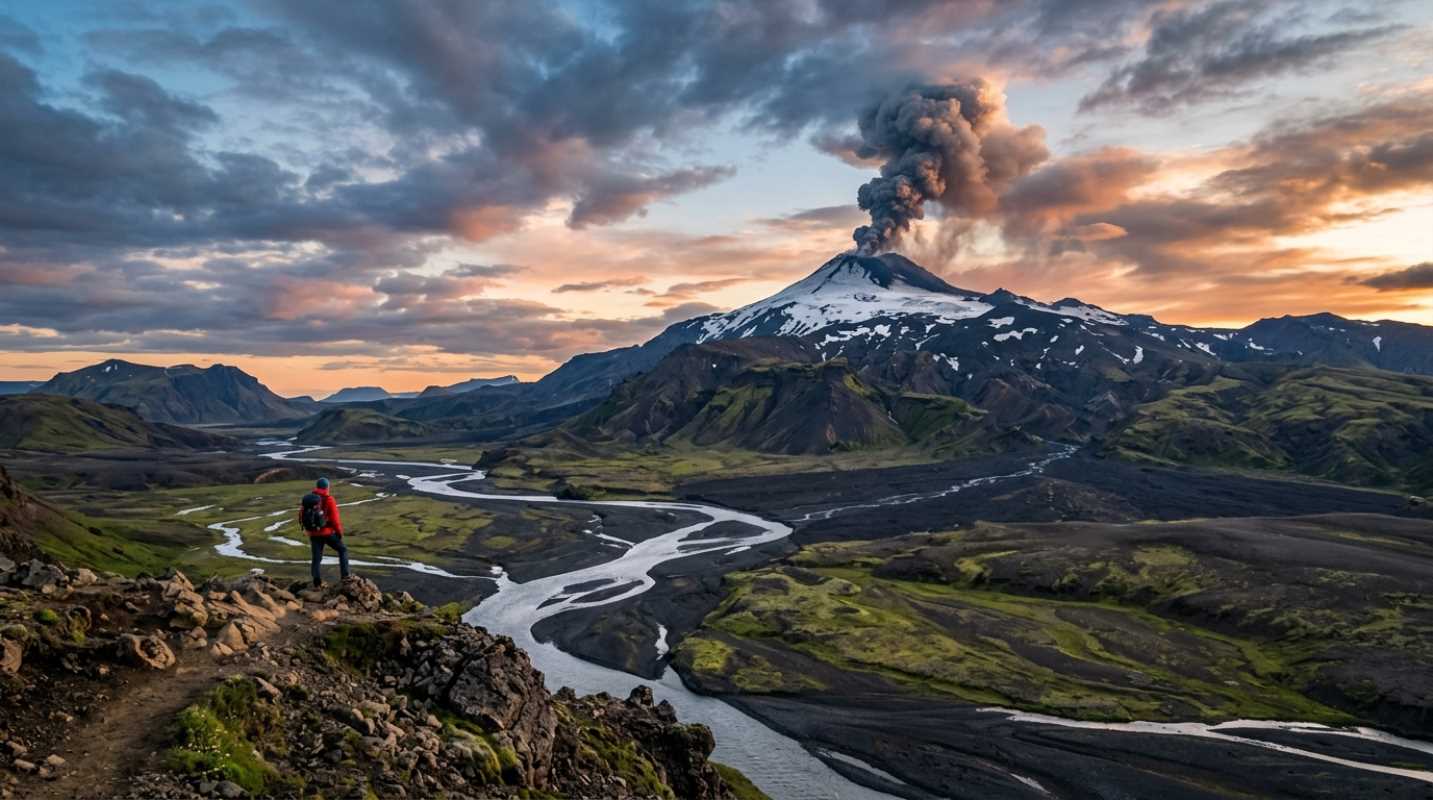
Iceland is famous for being a place where glaciers sit right next to active geothermal vents. This mix of ice and fire creates some of the most surreal sights you will ever see. Picture pitch-black basalt rock cutting through bright white snow. It looks less like Earth and more like a distant moon.
The Reykjanes Peninsula in southwest Iceland is currently the center of this geological drama. If you have been following the news, you know this area has been going through an intense volcanic cycle.¹ The region saw massive fissure eruptions along the Sundhnúksgígar crater row. These were not your typical mountain peaks blowing their tops. Instead, long tears in the ground opened up, sending curtains of orange lava high into the air.
If you want to experience this power without the active lava flows, you can head to the Thrihnukagigur volcano. It is the only place on Earth where you can take an open elevator 120 meters down into a cold, colorful magma chamber. The colors on the walls are mind-blowing, painted by ancient mineral deposits. This incredible natural beauty explains why Iceland welcomed over 2.2 million visitors recently, with travelers eager to experience this wild terrain.²
Sculpting the Earth: The Art of Molten Rock Formations
When lava cools down, it does not just turn into boring black dirt. It sculpts the land into mind-bending geometric shapes. Think of it as the natural design work of the Earth.
Depending on how fast the molten rock cools, it creates entirely different structures. Here are a few of the coolest formations you can find on your travels
• Columnar Basalt: These are perfect hexagonal pillars that look like they were carved by hand. They form when thick lava cools slowly and contracts. You can find massive walls of these columns in Iceland and Northern Ireland.
• Obsidian Fields: This is natural volcanic glass. When lava with high silica content cools almost instantly, it cannot form crystals. The result is a shiny, black glass that is incredibly sharp.
• Lava Tubes: These are underground tunnels left behind by ancient rivers of molten rock. When the top layer of a lava flow hardens, the liquid underneath keeps flowing, leaving a hollow cave behind.
The Ring of Fire Indonesia and the Pacific Giants
Now, let's head to the Ring of Fire, where the tectonic plates are constantly grinding against each other. East Java in Indonesia is home to some of the most dramatic volcanic environments you will ever experience.
Mount Bromo sits inside the Tengger Sand Sea, a massive plain of grey volcanic sand. Standing there feels like walking on the surface of Mars. Just a short trip away is the Ijen Crater, famous for its electric-blue flames. These flames happen when high-pressure sulfuric gases escape the earth and ignite in the air. At the bottom of the crater sits a highly acidic, bright turquoise lake. It is a stunning, sensory-overloading experience.
These places are not just tourist spots. They hold deep cultural and spiritual value for the local people. Every year, local communities climb Bromo to throw offerings of fruit, flowers, and other items into the smoking crater to appease the mountain spirits.
Further across the Pacific, Chile's Villarrica Volcano rises with a near-perfect snow-capped peak. It is one of the few places on Earth with an active, bubbling lava lake inside its crater. Imagine looking down into a pit of churning orange liquid while standing on a massive glacier.
Then you have Kīlauea in Hawaii, a shield volcano that has been actively reshaping the Big Island. Instead of explosive blasts, Kīlauea slowly pours fluid basaltic lava into the sea, creating new land right before your eyes.
If you are ready to plan your own adventure to these active environments, here are the top volcanic regions to add to your bucket list
Preserving the Inferno: Responsible Travel to Volcanic Sites
As exciting as it is to stand near an active volcano, you have to remember that these are highly unpredictable giants. Conditions can change in a matter of seconds. Volcanologist Dr. Jo warns that these systems are cyclical, and safety is never guaranteed.³
To make sure you get back home safely, you need to follow some basic ground rules
• Stay on the Trails: This is the most important rule. Just recently, a tourist at Hawaii Volcanoes National Park fell 30 feet down a cliff after dark because he stepped off the path to get a closer look at Kīlauea's lava flow. He survived, but it could have been fatal.
• Watch the Air Quality: Active vents release toxic, invisible gases like sulfur dioxide and hydrogen sulfide. Always check the wind direction and wear a high-quality respirator mask when you are near active fumaroles.
• Hire a Guide: For tough climbs like Mount Etna, local guides are often mandatory above certain altitudes. They know the terrain, they monitor gas levels, and they know the fastest way out if things go wrong.
• Wear the Right Gear: Volcanic rock is as sharp as broken glass. Leave your sneakers at home and wear sturdy, ankle-supporting boots.
These environments remind us that our planet is alive and constantly changing. If you treat these powerful places with the respect they deserve, you can safely witness the raw, beautiful process of the Earth rebuilding itself.
Sources
1. Where to Visit a Volcano
https://www.discovertheworldeducation.com/blog/where-to-visit-a-volcano/
2. Iceland Tourism in 2025: Exploring the Land of Fire and Ice through Numbers
https://gowithguide.com/blog/iceland-tourism-in-2025-exploring-the-land-of-fire-and-ice-through-numbers-5833
3. Is Visiting an Active Volcano Safe?
https://www.outsideonline.com/adventure-travel/advice/is-visiting-an-active-volcano-safe/?scope=anon